
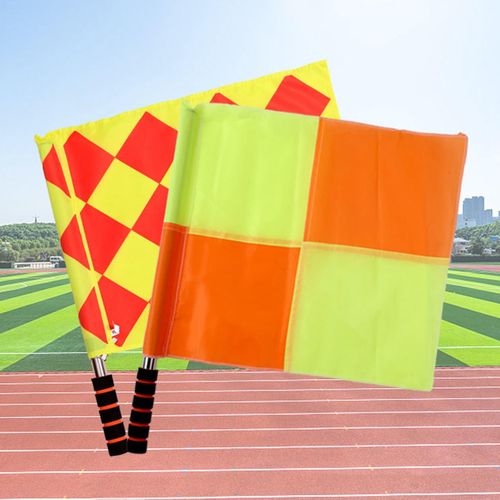


Description
Referee flags are an essential tool used by assistant referees (also called linesmen) in various sports, such as soccer (football). They are used to signal decisions and communicate with the main referee and players. Here are the primary functions of referee flags:
1. Offside
- Indicating when an offside offense has occurred.
- The assistant referee raises the flag and points it in a specific direction based on the position of the offside offense.
2. Throw-ins
- Signaling which team has possession for a throw-in.
- The flag is pointed in the direction of the team that should take the throw-in.
3. Corner Kicks and Goal Kicks
- Indicating whether the ball has crossed the goal line and whether it should result in a corner kick or a goal kick.
- The flag points to the appropriate corner or goal area.
4. Fouls and Misconduct
- Drawing the referee’s attention to fouls or misconduct not seen by the referee.
- The assistant referee waves the flag or holds it steady to signal an issue.
5. Ball In and Out of Play
- Signaling when the ball has completely crossed the touchline or goal line.
- The flag is held straight up initially, then pointed in the direction of the restart.
6. Substitutions
- Indicating when a team wants to make a substitution.
- The assistant referee holds the flag above their head with both hands.
7. Goal Confirmation
- Assisting the referee in confirming whether a goal has been scored (e.g., if there’s doubt about the ball crossing the line).
- The assistant referee may communicate with the referee using the flag if necessary.
8. Assist in Managing the Game
- Helping with off-the-ball incidents or when players engage in unsporting behavior.
- The flag can be used to stop play and notify the referee discreetly.
Flags serve as a non-verbal communication tool to maintain flow and accuracy in the game. In professional settings, referee flags often have built-in electronic systems to notify the main referee with a vibration or signal.

Reviews
There are no reviews yet.